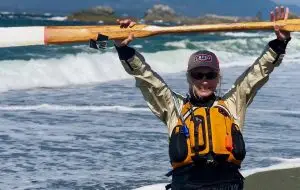
While some paddlers entering their 60s, 70s, and 80s ask themselves “Can I still do this?”, Roz & Jeff Tonner asked themselves “Can I try this for the first time?”
At 67 and 63 respectively, Roz & Jeff bought their very first sea kayak – a Seaward Passat G3 (a double, with all kinds of space for gear!) directly from the factory in Chemainus. While that may sound like a normal Sunday afternoon activity, they drove all the way from their home in Edmonton to do so. That was in 2019.
On their way home, they passed through Sechelt to visit a friend, who pointed out Susan Conrad’s book ‘One Woman’s Journey Through the Inside Passage’ on her book shelf. As soon as they arrived back in Edmonton, Roz bought a copy. While reading it she thought “WTF – why don’t we do this?!” – a question, I might add, that folks don’t ask themselves often enough when trying something new.
Jeff, a bit more skeptical, began reading reports of kayaking incidents with the BC Coast Guard, where he noticed a trend: nearly all incidents involved paddling in inclement weather. Retired in 2014, with no agenda and no need to move fast, Jeff knew they could hunker down and take as many weather days as required – there was no need, in his mind, to paddle in any conditions other than completely safe.
The couple decided that they were up for the journey: the famous Inside Passage.
From sea kayak purchase to one of the most acclaimed distance kayaking routes in the world might seem ambitious, but Roz and Jeff weren’t starting from scratch. Far from it – they have bike packing trips in 31 countries under their belt. They understand how to camp in the backcountry, improvise when things go wrong, and play it safe when conditions demand it. Although, as Jeff points out, you can’t just skid to a stop and put down your kickstand on a kayak.
Maybe for the best, life got in the way, and the COVID-19 pandemic prevented Jeff and Roz from embarking on their journey. Over the subsequent years, their new Passat G3 saw some serious nautical miles – roundtrip from Victoria to Nanaimo, Desolation Sound, Nootka Island, and Gwaii Haanas in Haida Gwaii (twice!).
Jeff & Roz want to make it explicitly clear that they are not elite expedition paddlers; they believe that ordinary people, like them, can undertake ambitious adventures with sufficient preparation (and confidence).
Eventually, it was time to dive back into Plan A, and dig out all of the charts purchased way back in 2019. They really were committed right out of the gate. To commit verbally – sure. But to buy the charts? That’s the sea kayaking equivalent of getting engaged!
Last year (2025), Jeff & Roz were on a bike packing trip in South America when an email popped into their inbox – SKILS had sent out a message to their subscribers promoting a guided trip from Bella Bella to Port Hardy. They looked at each other and said “What the hell! Let’s do it. This is our sign!”
Their philosophy: eventually, you have to stop waiting and go. “The clock is always ticking,” says Jeff.
While not the entire Inside Passage as originally planned, the couple took the trip with SKILS as an opportunity that they were up for the challenge – but it would be nice to ensure that with the comfort of having guides present! After completing the southern half of their intended journey, they were elated – not only did they confirm to themselves that they did have what it takes, but the knowledge gained from the SKILS expedition ensured they could do so alone.
Instead of giving themselves a break, or trading their paddles for peddles yet again, Jeff & Roz kept the momentum and committed themselves to finishing the remainder of the adventure. In 2026, they would paddle – just the two of them – from Prince Rupert to Bella Bella.
Jeff claims trip planning is just as enjoyable as being out there – he calls it the foreplay. Before the trip, the couple pored over sites on the BC Marine Trails map to make their plans A, B, and C – including guidelines from First Nations whose Territories their journey would take them through. Jeff then exported the sites using the Select Sites & Data Download tools on the map – organized neatly into a .csv file to print and pack with their gear. The sites from the BCMT map were marked on their seven-year-old charts, and their coordinates loaded into a Garmin inReach.
The couple both lauded the benefits of having the most up-to-date information possible when planning a trip of this caliber, noting that much of the information in paper guidebooks they consulted led them to overgrown or once-was sites, no longer suitable for camping.
What might look like an exam prep book is actually Jeff’s Paddle Plan – full of information and location details of each site, tides for the duration of the trip, emergency information, and more.
While Jeff filled his duotang, Roz set to work on food prep. “The food on the SKILS trip was incredible – gourmet, even – but they were taking my main camp job away!” explained Roz. She was excited to be doing it all on their own.
In the spring, BC Marine Trails co-hosted a food prep workshop with SKILS. While Roz missed the date, she was able to access the webinar recording later through the BCMT member portal.
The learning from SKILS didn’t end in Port Hardy – Roz was amazed at host Nathan Slater’s use of freeze dried food in lieu of dehydrating meals in advance.
Reflecting on the trip, they loved this new approach – dehydrated meals take a few hours to soak properly, and even more prep time on the front end. Freeze dried ingredients were not only quick and easy in camp, but took away a significant portion of the front end work – they just had to click order!
While Roz ordered from ‘Briden Solutions’ in Calgary, there are many options for freeze dried food orders in the Lower Mainland & Victoria.
Roz's Dehydrated Chicken Mango Curry
- Cook time: 20 minutes
- Servings: 2
- 1 1/2 cups minute brown rice
- 1 cup freeze dried chicken (hydrate in water for 15 min)
- 2/3 cup freeze dried mango (hydrated)
- 1/3 cup freeze dried peas (hydrated)
- 1/3 cup freeze dried green beans (hydrated)
- 1/2 cup powdered Coconut milk (with one cup water)
Spices
- 1 TBS Curry
- 1 TBS Garam Masala
- 1 TSP Ginger
On MRS Reactor Stove (or similar), boil minute brown rice until cooked.
On Primus Omni Fuel Stove (or similar), mix coconut milk & spices. Add all freeze dried ingredients. Simmer at a boil for a few minutes. Spoon over cooked rice & enjoy!
The Trip: Prince Rupert to Bella Bella
- 23 days
- 18 days on water
- 198 Nm | 366 Km
- First Nations Territories: Gitxaala; Kitsumkalum; Lax Kw'alaams; Metlakatla; Gitga'at; Haisla; Heiltsuk; Kitasoo Xai'xais
The couple, now 74 and 70, packed their van in Edmonton – using Jeff’s checklist to ensure nothing was left behind – and set off west. They dropped their kayak and gear in Port Edward before Roz drove the van to Prince Rupert, where it would await their return.
Steve from Skeena Kayaking shuttled her back to the launch – a service they noted was cheaper than a taxi – while Jeff got busy packing their kayak.
They launched from Port Edward on July 4th, en route south. While most paddlers travel in the opposite direction, the couple pointed to the practical fact that taking the ferry from Bella Bella would be much easier once their food was all eaten and supplies were dwindling – a few IKEA bags fewer dramatically eases a travel day!
On the water, they found exactly what they were looking for: solitude. They would come across no other paddlers until day 21 of their 23 day journey. While they loved their adventure with SKILS the year previous, it helped them learn that what they truly appreciate about kayak expeditions is peace, quiet, and getting away from people.
In regards to weather throughout the journey, “we had everything” said Jeff. But, following their original plan, they were able to hunker down for days at a time when the winds really blew. “If you’re planning a similar trip, get used to rain – you’ll be getting a lot of it”, Jeff continued.
The couple had arranged with their friend Cam in Vancouver to send them the ‘Windy’ weather forecast for their exact location, a task he enjoyed just as much as they valued getting the reports – it made him part of their trip. “When you listen to the marine radio – they’re talking about way off the coast. What is happening on the inside? Windy (and Cam) knows,” explained Jeff.
In anticipation of frequent (and sometimes heavy) rain, the couple packed two strong lightweight tarps – one for over their tent, and another to create a dry kitchen/living area. Jeff recommends honing your knot skills beforehand – you don’t want to be figuring it out in the pouring rain.
On the second night of the expedition, they were camped at a public river inlet on the edge of the small North Coast community of Oona River (population ~30) – a backup after their plan of camping at McMicking island was kiboshed by signs of an active bear. The rain was so heavy that they had to dig trenches around their tent to redirect water flow. In the downpour Roz tripped over a guyline, ripping one of their two tarps – with 21 days to go, there was no way they could comfortably finish with only one tarp.
Roz wandered into town to see if she could find a needle and thread to save what they could. She appeared back at camp, exclaiming “grab the tarp – we’re going in for coffee – and a sewing machine!” Roz had met a local couple, living in a rainbow coloured house, who invited them into their home for coffee, a visit, and of course, a bang-up job fixing the tarp.
During their time in Oona River they discovered many of the seaside homes operate as B&Bs, a luxury they certainly plan to make use of next time – no water trenches needed!
As the trip progressed, they were nervous about Grenville Channel, known as “The Ditch” – an area they had been repeatedly warned about. Long, narrow, and supposedly full of boat traffic, it would be hard to avoid large wakes. Once they finally began this section of the journey, “it was BEAUTIFUL,” exclaimed Jeff. “We didn’t encounter any issues here at all, smooth paddling”.
Throughout the steep cliffs of the inside passage, the couple found endless water falls, bears, whales, sea otters, and the serenity they craved.
They were interested to find evidence of a decrease in paddlers undertaking the Inside Passage throughout the years. A log book in a Fisheries and Oceans Canada (DFO) cabin near the ‘Lowe Inlet’ camp site showed consistent entries 20 years ago. In recent years, there have only been four or five entries from paddling groups.
When asked if they learned anything new about each other on this trip – they agreed ‘likely not’ – they’ve been doing back country adventures together for far too long for there to be any surprises. This, in part, is what makes a multi-week expedition so smooth. When they hit the shore they each have their dedicated tasks. No matter the site, they each know what they need to do, and they get it done.
In a few cases, they were relying on site information from outdated guidebooks in areas where landings are few and far between. Finding a site had completely changed, or was no longer usable, led to the hardest days of the expedition. When you think your paddling day is over, and it is only really just getting started, it’s a tough pill to swallow. “You just have to do it – there is no other option. It’s tonight, it will be over tomorrow – that’s all it is,” says Roz. “If you have to camp on a gravel bar with your feet higher than your head – who cares!” In some cases, the couple were camped (unplanned) on beaches so steep they had to fill their tent with gear to prevent it from sliding down the shore.
In another instance, when leaving from ‘Flat Point’, they pulled out at an ‘urgency’ camp site when the wind and tides did not cooperate – not an emergency, but an urgency. “We couldn’t really complain. This particular spot even had a penthouse bedroom with nature’s shag carpeting!” said Roz. The urgency site they found, they noted, was pure luck, and likely not accessible at all tide heights or times of year.
When arriving at Klemtu, the couple had a food drop waiting for them at the post office. They had rationed so well that the drop ended up being unnecessary, so they gifted it to the crew of scuba divers working for Kitasoo Xai’xais Watchmen Program.
The generosity was soon returned. A young man on a Kitasoo Xai’xais fishing boat cut them off a slab of salmon as soon as he heard of their journey. Then, a roofing contractor from Abbotsford who had recently been taught canning by an elder offered them two jars of salmon for the remainder of their journey. The youth marine program in Klemtu, called ‘SEAS’, even let the couple pitch their tent in their building for the night to dry out.
“The people in Klemtu were amazing,” said Jeff. “The people we met on the journey – from the couple in Oona Bay to the locals of Klemtu – ended up being the highlight of this trip, even though we do these trips to get away from people! Isn’t that the craziest thing?”
Jeff & Roz did note that the beach at the ferry terminal in Klemtu was far less hospitable (large boulders) than the one waiting in Bella Bella, for those wondering which may be a better launch point.
“We had been elated when we made it to Port Hardy with SKILS, but when we arrived at Bella Bella, totally independently, I was emotional” said Roz, overcome with what they had accomplished. When the couple boarded the ferry to return north they were greeted by cheers from the staff.
“Holy Dinah, we passed you guys so many times!” said one ferry worker.
A tip for others considering ferry assisted expeditions: the couple brought wheels to roll the boat, a necessity for an 85-lb Passat G3. They emptied the boat into ‘the famous IKEA bags’ and walked straight onto the ferry, bound for Prince Rupert (even equipped with kayak racks!).
When asked to pick a favourite moment from the trip, they both agreed: the whole was greater than the sum of the parts. They couldn’t pick just one thing. As for advice for other adventurers, Jeff offered “don’t forget to smell the roses – and the whales!”
Seven years after buying their first sea kayak, Roz and Jeff had finally completed the journey they’d once looked at on a bookshelf and thought: Why don’t we do this?
And they invite you to do the same – what trip have you been putting on hold?
Campsite summary
Dotted lines are ferry routes, not Roz & Jeff’s expedition route. Click through from right to left for their campsites from Port Edward to Bella Bella.