Coastal Caretaker Portal
Recent Coastal Caretaker News
Summer 2026
Seeking Video Submissions
- “I caretake because…”
- “When I’m on the water I always…” “
- “Every site I visit, I…”
- “If I find a fire ring, I…”
- “If a trail is overgrown, I…”
- “I leave every site I visit better than I found it”
- “If I’m unsure what to do, I…”
- “To submit SCRs, I…”
You do not need to film all of these, and you are welcome to speak in your own words instead. These are just prompts to guide you.
Demonstrating actions like dismantling fire rings, clipping trails, taking photos of site features, collecting marine debris, etc. will be of high value to us as well!
- Please film in landscape orientation on a phone
- Please double check that audio is clear and adequately loud
- Wind and outdoor conditions are fine, but if you can find a bit of shelter for clearer audio, that is helpful.
Authentic, in-the-moment footage is more important than ensuring it is fully polished.
Playlist
0:16
Summer 2026
Seeking Map Photos
Site Condition Reporting can be as simple as photo submission! Check the map for sites without photos, subpar photos, or lacking certain angles or features – then, add them to your next trip! Or, click the button below to see which sites need your help!
Ensure people are not in site photos as this is a requirement to be added to the map.
May 1st, 2026
Site Condition Reporting Contest Launched!
Our Site Condition Reporting Contest has launched for 2026!
From May 1st to September 30th, each submitted SCR is a chance to win one of three great prizes:
April, 2026
Record Breaking Gerald Island Cleanup
Read the report from BC Marine Trails on our recent record breaking event on Gerald Island!
November, 2025
Stats Released from 2025 Site Condition Reports
Read the report from BC Marine Trails on Site Condition Reporting in 2025.
November 20th, 2025
Coastal Caretakers Recognized for work on West Ballenas Island
BC Marine Trails’ Coastal Caretakers were recently recognized by the BC Parks Foundation in an article, titled ‘From Users to Caretakers: Volunteers Steward West Ballenas Island’
Coastal Caretakers must sign a waiver annually to participate in the program. Waivers reset on April 1st of each year, and are independent of waivers for individual stewardship events like Gerald Island Invasive Species Removal, or Vargas Island Marine Debris Removal.
Please note: You are not an official Coastal Caretaker, and do not have permission to act as a Caretaker on behalf of BC Marine Trails until a waiver is signed.
V
visiting
a
site
O
observing
changes
and
impact
I
interacting
with
other
visitors
C
caretaking
to keep
sites
natural
E
exchanging
data with
BCMT
Visiting Sites
How can I effectively help BC Marine Trails?
- If you begin planning a paddling trip using the BC Marine Trails map, you might print out a spreadsheet of the sites you are planning to visit and the information posted about those sites. As you examine the site information, if you notice there are photos missing, make a note to take specific photos while you are there.
- In the BC Marine Trails monthly newsletter, you may see a notice asking if anyone is planning on paddling in a particular area. If that is you, then respond to the notice. Many of us assume that someone is paid to go out and do Site Condition Reports or the more detailed site assessments. Actually, it’s volunteers like you who keep the map current and who have made it into such an amazing tool for exploring the coastline.
- When you are out exploring an area, if you see a promising site that is not listed on the BC Marine Trails map, send in a Site Condition Report and photos. You may be the first person reporting on this site or you may be one of many. Either way, your information gets added to our database and becomes part of the conversation with land managers about which sites to list on the map.
Why are some sites not shown on the BC Marine Trails map?
- Before a site can be listed on our map, we have a process we follow. The site must have been assessed for accessibility, safety, and most importantly, we must have permission from the land owners or managers to include the site on our map. This process takes time. While we have over 1400 sites on our map, we have at least as many sites waiting to be discussed. The Site Condition Reports you submit help us to gather the data we need for these discussions.
- It’s important to note that BC Marine Trails does not own the sites shown on our map. Our mission is to work with First Nations communities and stakeholders to build, protect and promote a public network of marine trails allowing safe recreational navigation of the BC Coastline with minimal impact on the environment. Through respectful discussions, we are working together with these partners to help secure long term public access to the BC Coast.
- It’s equally important to respect sites that have cultural significance for First Nations communities. As we work with communities, we explore options for safe recreational navigation while ensuring we are not directing visitors to sensitive ecological areas, bird nesting sites, burial sites or ceremonial sites.
Observing
During a visit to a site, how do we know what observations are useful to share?
- Begin by thinking about what you read from the BC Marine Trails map before coming to this site. Was there something more you would have liked to know about the landing, the camping possibilities, any evidence of trampling? Did you find examples of rare flora and fauna other visitors might like to know about?
- While you are at a site, what suggestions can you make in your Site Condition Report (SCR) to keep the site pristine for others to appreciate? (e.g. recommending a composting outhouse or green throne may not result in a new outhouse for your next visit, but in heavily used sites, these recorded observations help build a case for preserving the natural site). The same is true for a clearly marked trail in heavily used sites instead of having everyone trample the flowers.
- Some sites have Visitor Logs and while visitors may have written in the logs, that data may not have been shared. Taking a photo of the contents of the log and sharing it with your Site Condition Report (SCR) is another way to give voice to the site, not just your voice but other visitors’ voices too.
If I report in the SCR that a specific site requires maintenance, will it get addressed?
- BC Marine Trails is able to post relevant information on the map for a specific site so users are aware of potential hazards or issues identified.
- Depending on who manages the land, action may or may not be taken to address the maintenance concern raised. For example, if the land is managed by BC Parks, Recreational Sites and Trails BC, or First Nations communities, the information is passed along for the land managers to decide what to do with the resources and time they have.
Interacting with Others
May I promote membership with Coastal Caretakers and with BC Marine Trails?
- Absolutely! People may know about our mission and the data on our map, but our members’ actions bring these to life. Without our members, we could not do the work we do and we are grateful you want to do this work with us!
- Membership fees, donations, and volunteer commitment allow us to move forward with our mission, so please promote BC Marine Trails in whatever way you can. Your actions lead by example and we love it when you let others know what you are doing!
What if I feel uncomfortable talking to someone who has lit a fire above the high tide line?
As a Coastal Caretaker, we appreciate any actions you take to share the Marine Code of Conduct but you are not the Park Warden, land manager, or owner. Friendly conversations work best. Modeling by building your small fire below the high tide line works well, too.
How can I get Code of Conduct or Coastal Caretaker decals or cards to share with others?
Thanks to a recommendation from one of our Coastal Caretakers, we have business cards with the Coastal Caretakers VOICE acronym on one side and the BCMT Code of Conduct on the other. We also have Code of Conduct decals for putting on kayaks. If you would like to pass these on to your friends or club members or if you are a kayak rental company and want to share these with your customers, send BCMT an email with your mailing address, phone number, and the number of Coastal Caretaker/Code of Conduct business cards or Code of Conduct decals you would like to receive to share with others: volunteer@bcmarinetrails.org.
Is there a BC Marine Trails poster to post in stores or at boat launch areas?
Yes — find one here you can print and share! We also have tri-fold brochures available — reach out to scutcliffe@bcmarinetrails.org with any questions on physical resources. Please ask the boat launch manager or business owner for permission before putting up posters or dropping off brochures.
I don't live in Coastal BC. How can I make a difference from where I live?
- Write an article on a recent trip along BC’s coastline.
- Become a member or donate directly to one of our three pillars or the general operations of BC Marine Trails.
- Let your friends know why you are supporting BC Marine Trails. Maybe your enthusiasm will encourage your friends to become members, too.
- Like our Facebook and Instagram posts; share them with your friends.
- Model the Marine Trails Code of Conduct in whatever coastal spaces you visit.
Caretaking at a Site
If I clean up a site that has marine debris, what should I do with the debris?
- If it is a small, manageable amount that can be removed and you have space, remove the debris and put it in with your household garbage or recycling after your trip is complete.
- If you are leaving the debris at the site, collect and sort the debris, then store it far above the high tide line, in a place well above any logs. You want to avoid the debris being redistributed into the ocean once storm surge and king tides arrive in the winter months. Take photos to submit with your SCR to show the location, quantity and type of debris. This data is shared with cleanup partners and may result in the debris being removed at a later date!
- A few sites may have a collection sign indicating that debris materials can be stored by the sign for future clean up activities. This is rare at the moment, but kudos to those who are setting up debris collection sites for easy removal at a later date!
- Please note in your Site Condition Report if you completed any of the above clean up actions and include photos of the debris too!
Is it OK to dismantle fire rings (a ring of stones around a campfire)?
If you come across a ring of stones around a pile of burnt wood, go ahead and toss the stones around the site and toss the wood into the water so the next group on the beach would never know someone had lit a fire in this spot. Caution: If you dismantle a fire ring, use a stick to check for hidden objects (nails, tin cans, glass) and take these objects away with you or add them to your debris pile high above the logs and winter storm surge areas.
Exchanging Data (Site Condition Reports)
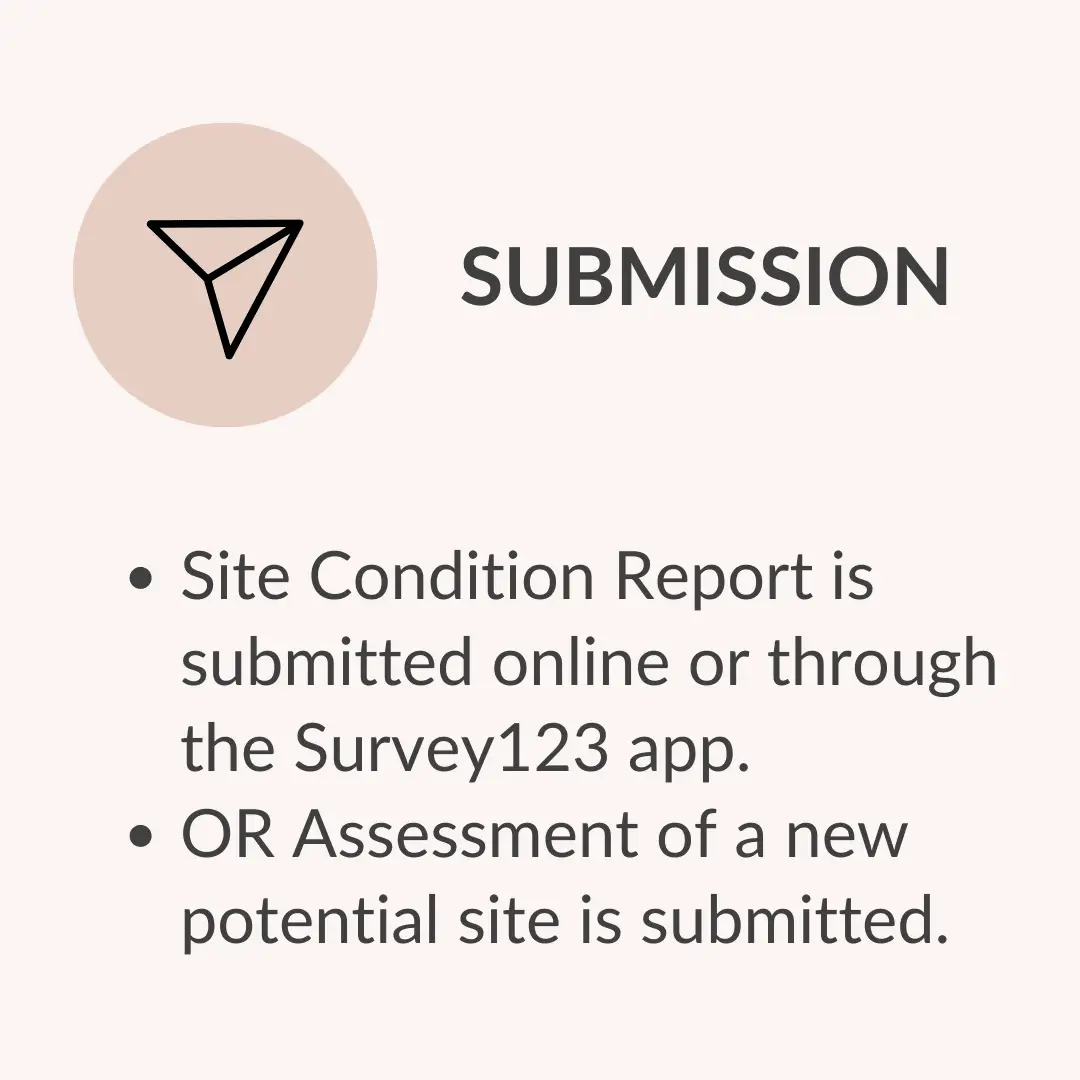
How do I download the Survey123 app? Do I need to use it?
Find a video walkthrough of loading the SCR form on the app here.
To download the Survey123 app, search ‘Survey123’ in the App Store, or Google Play Store. You should see the following icon:
Once downloaded, you will need to download the SCR form to the app. To do so, return to this page, and click ‘Go to form’ above. At this point, the SCR form should be available through the app.
If preferred, you do not need to use the app — it is always an option to record information in your notes app, notebook, etc. and then fill in the form in your browser from your laptop / desktop computer. To do so, click ‘Go to form’ above, and select ‘Open in browser’.
How do I report offline?
When using the Survey123 app, report forms can be filled out in the field, and they will automatically upload when you are back in service / wifi!
Alternatively, you can record relevant information in a waterproof notebook, and upload your findings when you are back home!
The printable PDF version of the SCR can be helpful — print off one for each site, or use only one as reference for your notebook.
Do I need to fill out all sections of an SCR?
Absolutely not! Fill out what you are able to. If all you have to submit is photos, that is great! Some information is better than no information.
Are all SCRs publicly displayed on the map?
- If an SCR submitter does not consent to have their name and SCR displayed on the BCMT member map, it will not be displayed.
- Our Regional Managers review SCRs, and if there is no issue or error, they are published on the BCMT member map.
- While we strive for quick updates, the time from SCR submission to publishing on the map is often a couple of days.
If I report in the SCR that a specific site requires maintenance, will it get addressed?
- BC Marine Trails is able to post relevant information on the map for a specific site so users are aware of potential hazards or issues identified.
- Depending on who manages the land, action may or may not be taken to address the maintenance concern raised. For example, if the land is managed by BC Parks, Recreational Sites and Trails BC, or First Nations communities, the information is passed along for the land managers to decide what to do with the resources and time they have.
Is it possible to submit short videos with the SCR?
Not yet! If you take a short video of your site, send it to our new communications outreach coordinator, Sam (scutcliffe@bcmarinetrails.org), and he may ask your permission to use it in our social media communications.
What size and type of photo should I attach to Site Condition Reports?
- Minimum size is 1280 x 720 px and under 12 MB.
- Take photos that provide users with better visuals about what to expect or watch for at a site: views of the approach, the landing, the tent site, geo location of debris and quantity/type, as well as location of any hazards (dangerous trees, buried metal).
Does BC Marine Trails share the SCRs with land managers?
At this time, land managers (BC Parks, Recreational Sites and Trails BC, Parks Canada, and some First Nations communities working with us) receive SCR data that is pertinent to their area, including which sites were cleaned and which sites need repairs.
On top of this, marine debris information is shared with cleanup partners like The Ocean Legacy Foundation, Rugged Coast, and Living Oceans Society.
Sharing as a Coastal Caretaker Community
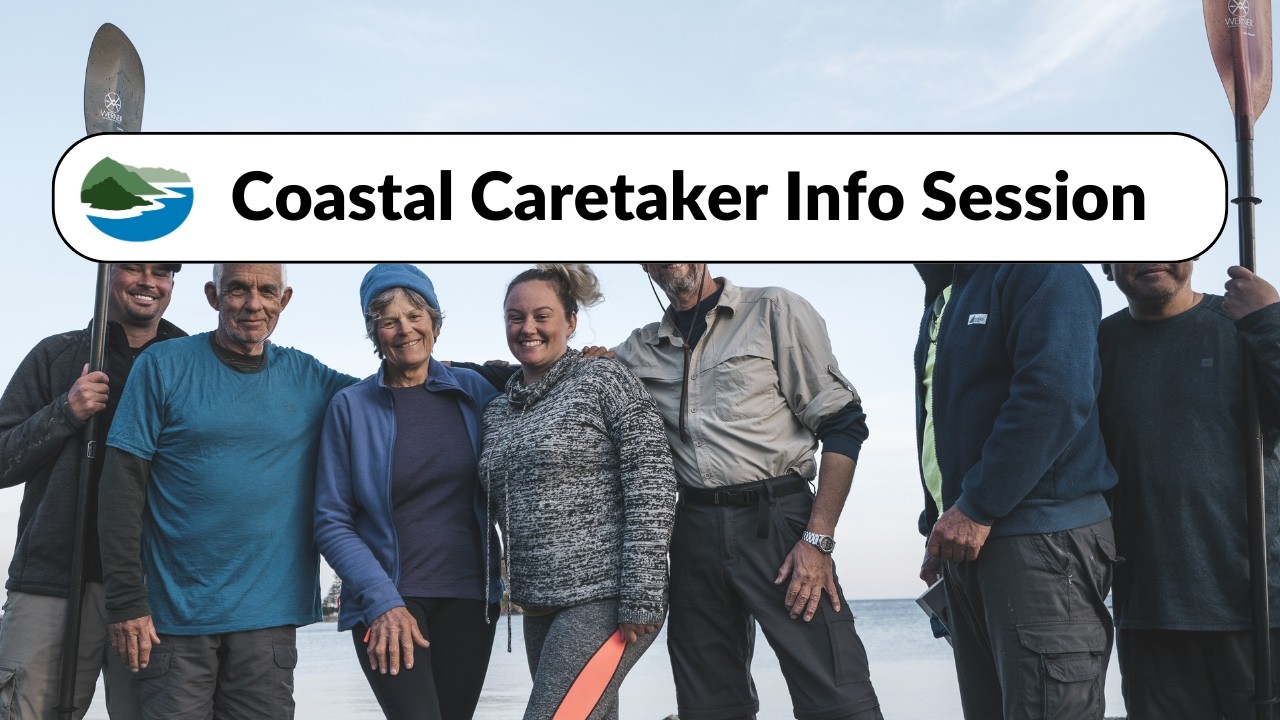
Are there information sessions to learn more as a Coastal Caretaker?
Yes, there are typically information sessions hosted on Zoom periodically throughout the winter and spring. If you are interested in an info session, reach out to volunteer@bcmarinetrails.org
May I share the information from Coastal Caretaker sessions with my friends, paddling club or recreational organization?
Yes, request a copy of the session information by sending an email to volunteer@bcmarinetrails.org. Of course, the information presented at each Coastal Caretaking sharing session will depend on the ideas from those participating and will change as the project evolves, so indicate whether you want information from a specific session or simply the most recent updates.
Thank you for being a Coastal Caretaker! It’s great to be volunteering alongside all of you!
Site Condition Report
Site Assessments
By filling out the longer Site Assessment form, you can provide more extensive data for a potential site that is not yet on the BCMT map. The Site Assessment form is more detailed and is not on the Survey123 app, but it will provide more information for the Trails Development Team to decide whether the undeveloped site should be added to the BCMT map.
When completing a Site Assessment, think about the types of information you’d like to know when planning a trip or choosing a campsite. See this overview for a detailed reference of what factors to consider. Visit at low tide if possible; it’s helpful for prospective paddlers!
You can print the overview to take notes in the field, then fill out the online form when you’re home. Alternatively, use a Word or PDF version to complete off-line.
To convert coordinates to the required decimal format, click here.
Site Assessment
Coastal Caretakers
56:52
Want to add your VOICE to this page, or our monthly newsletters? Reach out with a short quote and photo to Sam, at scutcliffe@bcmarinetrails.org
Karina Younk
“When I first joined BC Marine Trails I assumed someone was paid to visit sites and update the map. I quickly learned that a small group of volunteers were behind the updates of this incredible resource! I am very proud to report that we now have over 75 Coastal Caretakers, sending photos and reports of coastal sites they have visited during their coastal exploration. It makes me proud to see so many individuals eager to contribute to BC Marine Trails’ vision and mission. Thank you for believing in this work!”
Allan Edwin
“Apparently there is no word for ‘wilderness’ in the tongues of our Coastal First Nations. When they describe this place, the word they use is “home”. I like that. The Coastal Caretakers program was an easy choice. I take care of my home.”
Ken Sund
“When I paddle the coast, I pile debris above the tide line. Now, I’ll continue the effort and make sure to fill out Site Condition Reporting forms. A word of advice for other Coastal Caretakers: be cautious on slippery logs and tricky landings — remote coves often need kayakers like us to help keep them clean!”
Scott Speakman
“I caretake because it just feels good to leave a place a little better than I found it and make it nicer for the next person who shows up. It’s also my way of helping the coast stay wild and healthy by keeping our impact as light as possible.”
Reed Early
“It’s easy to submit Site Condition Reports. I just did one yesterday! The information is very helpful to regional managers, who keep the BC Marine Trails map up-to-date. With submitted photographs now accessible through the member map it’s even better for members!”
Gene Gapsis
“I have always loved being in the middle of nature, especially that which seems not to have been “touched” by man quite as much. That can be on a trail close to home, or along rugged, inaccessible beaches on the north coast. I find a bit of satisfaction and peace trying to be part of the solution to what are now obvious problems such as the proliferation of plastics or forever chemicals. In every aspect of my life, I try to live simply, and do one small thing for Mother Nature, from which I cannot separate myself. I know the Earth will heal herself once we are gone, but for now, It doesn’t matter where I am, I will pick up garbage, remove styrofoam, line or plastics from the ocean, or change my personal habits. In just the last 40 years, every beach seems to now have plastics becoming part of the foreshore. We can no longer ignore our impact. For that reason, being a Coastal Caretaker is, for me, a way of life.”
Ward Strong
“I love stopping in at remote BCMT campsites to see what sort of shape they’re in, particularly if the descriptions are scanty or there are questions about the site. I enjoy nailing down a concrete description, clearing out seldom-used tent sites or trails, and, if there’s space in the kayak, carrying out marine debris. “
Art Skoda
“I do it for the challenge and to keep our spectacular coast as clean as possible. I don’t like the idea that it is my generation that has created this pollution problem and that the garbage we are so carelessly creating has a far longer lifespan than me. Lately, I’ve been tackling marine debris at the Wya beaches north of Ucluelet.”
Connie Miller Retzer
“I volunteered to be a Coastal Caretaker because I admire and want to support BCMT’s initiatives, even if it seems like a rather small contribution. Most of my kayaking is locally based near Nanaimo, so initially I did not feel I could contribute. But then I realized my local area is new to someone else, and all contributions are useful!”
Donna Harrison
“Being a kayak guide, I am on the water a lot! As a Coastal Caretaker I have the opportunity to educate other kayakers I meet as to why we need to preserve our coastal environment. Visiting various marine campgrounds each year, I can see that people are really trying, and that makes me happy.”
Gwendal Castellan
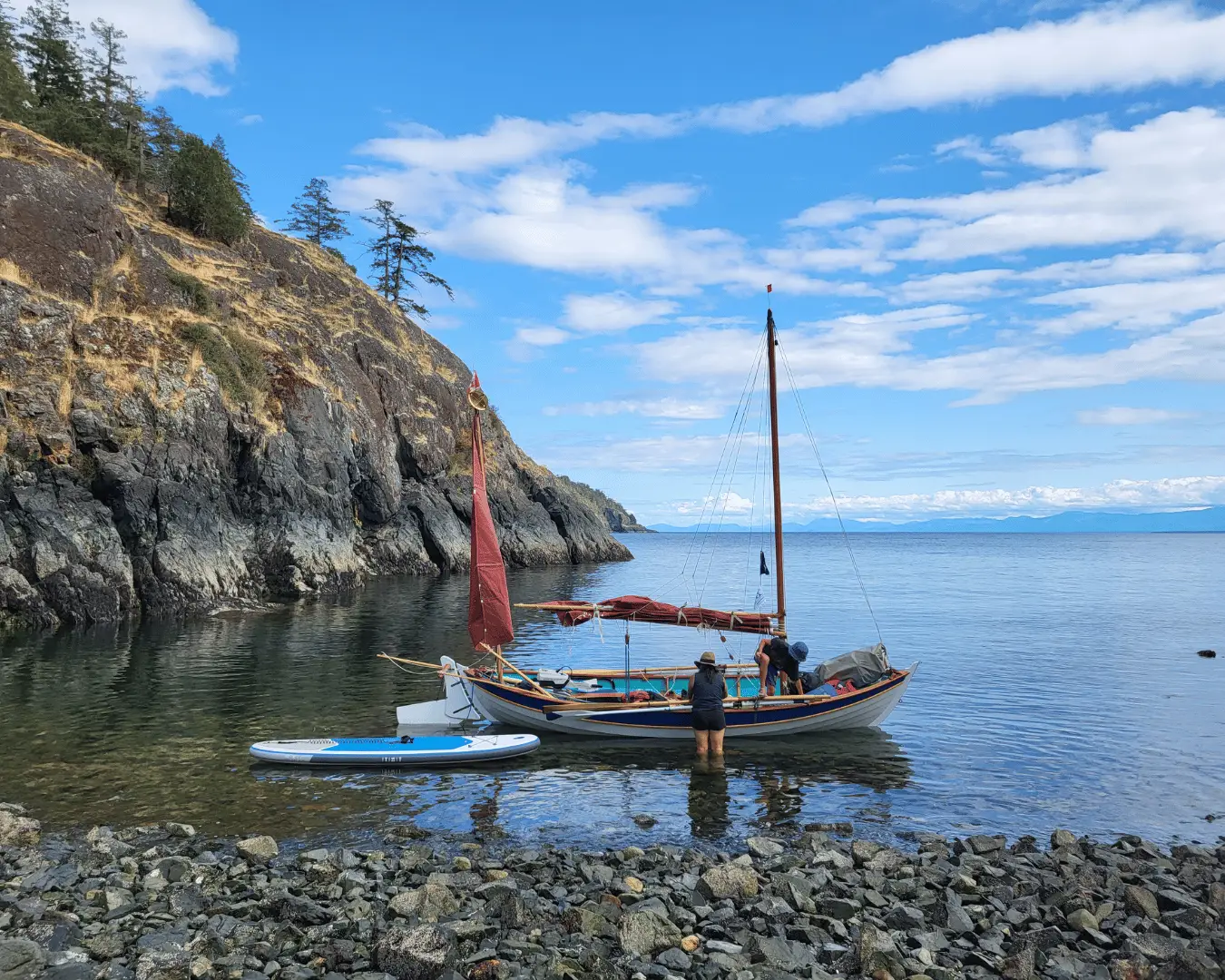
“I grew up learning to sail, to windsurf and paddle at the Jericho Sailing Centre in Vancouver. A few years ago the idea of taking my young children with me to explore the BC coastline and BC Marine Trails was part of what inspired me to build a 19’6″ wooden sailboat designed by Iain Oughtred called a Caledonia yawl. With a centreboard and no balast it can be beached just like a kayak but has the benefit of being able to row and sail. I launched the boat in 2021 and since have been rewarded with the confirmation that small un powered craft leave you with a more intimate connection to the ocean, the coastline and the elements. I appreciate the opportunity to contribute to a responsible stewardship of the community and the places we visit so that many generations to come will be be inspired by our foresight and care.”
Reale Emond
“I became a Coastal Caretaker because I find it a great way to educate others by example. Eventually, I look forward to seeing the whole world as Coastal Caretakers … (it may be a while before that goal is achieved). However, in the case of BC Marine Trails, we are a good, stable, and well defined organization which makes it very easy to get involved. It is a valid way of communicating and sharing our thoughts, knowledge and our love of our environment with other users. As a Coastal Caretaker, we have a vital role in gathering and dispersing data to other BCMT departments for assessments and further trail development or enhancement.”
Wayne Roberts
“As small boaters, we share an intimate connection with our environment, making our advocacy crucial for the entire coastal community. We are drawn to the romantic notion of wilderness — this has been challenged, however, as we find evidence of traditional occupation everywhere we go. This inspires us to find new meaning in our relationship with nature and our engagement with all communities.”
Fred Pishalski
“I feel that those of us who use the coast have a responsibility to do what we can to ensure it stays as pristine as possible so that other paddlers and those behind us can have the best experience possible. This is some of the best cold water paddling on earth and and it needs to be preserved.”
John Halliday
“As a paddler who enjoys multi-day trips, I always take advantage of the work done by Coastal Caretakers on the site map for planning my adventures. And, as a Coastal Caretaker, I strive to keep the site information current by reporting conditions that I encounter.”
Susie Youle
“Being a Coastal Caretaker makes you feel as if in some small way you are able to make a difference. You are the voice of that campsite. When you leave it in pristine condition, you have set an example for others to follow. You have made a contribution to the well being of our coast.”
Karen Jensen
“As paddlers, exploring our rugged and diverse coastal environment integrates us within its ecosystem. It’s our responsibility to support its preservation through safe and responsible behaviour, and advocating for others to do the same.”
Andrew Godfrey
“I love the impact of being a Coastal Caretaker. It’s visible, immediate, and meaningful. Often we’re travelling to places that are super remote — there is so little data about some of these sites unless we provide it. It’s a unique opportunity to have an impact that wouldn’t have happened without you.”
Liz Leboe
“We loved coastal caretaking on West Ballenas because it is a place we would otherwise not get to stay. It also was very satisfying knowing that we were helping to make it a better place for future kayakers to land and visit: by fixing some things and submitting an up-to-date site report.”
Evelyn Hamilton
“I really enjoyed my time on Gerald Island identifying and mapping wildflowers & other native species. It is great to do something concrete to help protect these Garry oak meadows, which are habitat for rare species and need the attention provided by the Coastal Caretaker’s invasive species removal program.”